Toyota AE86 Levin vs Trueno: Body Parts, Headlights and Conversion Differences
The Toyota AE86 Corolla Levin and Sprinter Trueno are two of the most recognisable classic Japanese sports cars. Both share the same AE86 platform and rear-wheel-drive engineering, but their front-end styling makes them immediately distinguishable. The Levin features fixed rectangular headlights, while the Trueno is famous for its retractable pop-up headlights.
For Toyota enthusiasts, understanding the difference between the AE86 Levin and Trueno is important when buying replacement body panels, restoring a classic Corolla, or planning a front-end conversion. Although the two models share many mechanical components, not every exterior part is interchangeable.
This guide explains the differences between Toyota AE86 Levin and Trueno body parts, headlights, bumpers, front fenders, and conversion requirements. It also covers early-model (Zenki) and late-model (Kouki) variations to help you identify the correct parts before purchasing.
1. What Is the Difference Between Toyota AE86 Levin and Trueno?
The Corolla Levin and Sprinter Trueno were two versions of Toyota’s E80-generation Corolla and Sprinter range, introduced in 1983.
Both were available with the AE86 chassis designation when equipped with the relevant 4A-GE-powered configuration. They shared the same fundamental rear-wheel-drive layout, engine family, suspension architecture, and general platform design.
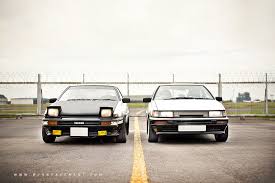
The main visual difference was the front-end design.
Toyota Corolla Levin AE86
- Fixed rectangular headlights.
- Conventional headlight mounting arrangement.
- Distinctive Levin grille and front bumper.
- More traditional front-end appearance.
Toyota Sprinter Trueno AE86
- Retractable pop-up headlights.
- Headlight motor and linkage assemblies.
- Different headlight housings and front-end components.
- Distinctive Trueno grille and bumper.
The Levin used fixed headlights, whereas the Sprinter Trueno used retractable headlights. The two models were closely related mechanically, with their most recognisable differences concentrated in their exterior styling.
This distinction is important because ordering a replacement headlight or front-end component based only on the AE86 model designation can result in purchasing an incompatible part.
2. Toyota AE86 Levin vs Trueno: Headlight Differences
The headlights are the most obvious difference between the two models.
Levin Fixed Headlights
The AE86 Levin uses fixed rectangular headlights mounted directly into the front-end structure.
Its headlight arrangement is relatively straightforward compared with the Trueno because it does not require retractable motors or moving headlight mechanisms.
When purchasing Levin headlights or related components, check:
- Left and right headlight assemblies.
- Headlight mounting brackets.
- Headlight surrounds and bezels.
- Front grille compatibility.
- Corner lights and turn signals.
- Headlight wiring connectors.
The exact components can vary depending on the production period and market specification.
Trueno Pop-Up Headlights
The AE86 Trueno features retractable headlights that rise when activated and retract when switched off.
Unlike the Levin’s fixed arrangement, the Trueno system contains additional mechanical and electrical components.
A complete Trueno headlight assembly may require:
- Left and right retractable headlight units.
- Headlight motors.
- Retractable headlight linkages.
- Headlight brackets and mounting hardware.
- Headlight covers.
- Front wiring and electrical connectors.
- Headlight control switches and associated wiring.
When buying used Trueno headlights, inspect the motors and linkages carefully. A headlight assembly that looks complete may still have damaged or missing mechanical components.
Can Levin Headlights Fit a Trueno?
Not as a direct replacement.
The two models use different headlight configurations and associated front-end mounting components. Installing Levin headlights on a Trueno requires a broader front-end conversion rather than simply changing the bulbs or headlight assemblies.
The same applies when converting a Levin to the Trueno pop-up headlight design.
3. Body Parts Differences Between AE86 Levin and Trueno
Although both models share the AE86 platform, their front-end body components are not universally interchangeable.
The different headlight designs require different arrangements for several surrounding components.
Front Bumper
The Levin and Trueno use different front bumper designs.
Their bumper shapes, mounting brackets, grille arrangements, and turn-signal configurations are specific to the corresponding front-end design and production version.
When replacing a front bumper, check:
- Levin or Trueno application.
- Zenki or Kouki specification.
- Bumper mounting brackets.
- Bumper support and stays.
- Turn-signal lamp compatibility.
- Front lip or spoiler fitment.
A bumper may appear similar in photographs but still require different mounting hardware.
Front Fenders
Front fenders are another important consideration.
The Levin and Trueno have different front-end styling and headlight arrangements, so their fenders must be selected according to the intended front-end configuration.
Before purchasing, verify:
- Left or right side.
- Levin or Trueno application.
- Zenki or Kouki specification.
- Side marker and indicator openings.
- Fender mounting points.
- Compatibility with the hood and bumper.
Hood and Bonnet
The hood is also part of the front-end compatibility equation.
Although both models share the general AE86 body platform, the hood and surrounding components must match the chosen front-end arrangement.
Do not assume that a Levin hood will fit a Trueno conversion without checking the relevant mounting and front-edge details.
Grille and Front Indicators
The grille and front indicator arrangements are different between the two models.
The grille is designed around each model’s front-end styling, while the indicators and corner lamps must match the bumper and fender configuration.
For a complete restoration, purchasing a matching front-end package is generally easier than sourcing individual components from different AE86 variants.
4. Zenki vs Kouki: Early and Late AE86 Differences
Another important consideration when buying AE86 body parts is the difference between Zenki and Kouki models.
These Japanese terms are commonly used by enthusiasts to describe the early and later production versions of the AE86.
- Zenki: Early-model AE86, generally associated with 1983–1985 production.
- Kouki: Later-model AE86, generally associated with 1985–1987 production.
The transition occurred during the AE86 production run, so the exact year alone is not always sufficient to identify every component.
Zenki AE86
Zenki refers to the earlier production version. Some exterior components feature early-design details, including specific bumper, grille, and indicator arrangements.
Kouki AE86
Kouki refers to the later production version. Certain exterior components received design revisions, which means some replacement parts may not fit earlier models without checking compatibility.
Which Body Parts Should You Check?
| Component | Compatibility consideration |
|---|---|
| Front bumper | Check Zenki/Kouki and Levin/Trueno |
| Bumper brackets | Verify mounting design |
| Front grille | Match model and production version |
| Turn signals | Check housing and connector |
| Front fenders | Check trim and side-marker details |
| Hood | Verify part number and front-end fitment |
| Rear lights | Check body style and production version |
Not every component changed between Zenki and Kouki. Some parts remained similar or were shared, while others received design revisions.
Important: Always verify the original Toyota part number before ordering. Production date, market specification, and body style can affect fitment.
5. Are AE86 Levin and Trueno Body Parts Interchangeable?
This is one of the most common questions among AE86 owners.
The answer depends on which component you want to replace.
Some parts are shared because both vehicles use the same underlying platform. However, the front-end components are more specific to each model.
Here is a practical compatibility overview.
| Component | Levin vs Trueno |
|---|---|
| Engine and mechanical components | Generally shared when specifications match |
| Transmission | Generally shared when specifications match |
| Suspension architecture | Shared platform |
| Front headlights | Not interchangeable directly |
| Headlight mechanisms | Trueno-specific |
| Front fenders | Verify model-specific fitment |
| Front bumper | Model-specific fitment |
| Front grille | Model-specific fitment |
| Hood | Verify exact application |
| Front indicators | Verify model and version |
| Rear bumper | Often shared, verify body style and version |
| Rear lights | Verify market, body style, and production version |
| Doors | Depends on coupe or hatchback body style |
| Interior components | Many shared, some trim-specific |
The most important distinction is that Levin and Trueno compatibility should not be confused with Zenki and Kouki compatibility.
A part can be designed for a Levin but still be incorrect for a Kouki Levin.
Similarly, a Trueno bumper from an early production model should not automatically be assumed to fit every later Trueno configuration.
6. How to Convert an AE86 Levin into a Trueno
Converting an AE86 Levin into a Trueno-style front end is a popular modification among Toyota enthusiasts.
The conversion changes the fixed-headlight front end into the familiar retractable-headlight arrangement.
However, it requires more than replacing the headlights.
Essential Parts for a Levin-to-Trueno Conversion
A typical conversion should be planned around the following components:
| Required component | Purpose |
|---|---|
| Left and right pop-up headlight assemblies | Replace fixed headlights |
| Headlight motors | Operate retractable headlights |
| Headlight linkages | Connect motors to headlight assemblies |
| Headlight mounting components | Secure the new assemblies |
| Trueno hood | Match the intended front-end configuration |
| Trueno front fenders | Provide compatible exterior fitment |
| Trueno front bumper | Complete the front-end appearance |
| Trueno grille | Match the headlight and bumper design |
| Indicator and corner lamps | Complete the lighting arrangement |
| Relevant wiring and switches | Operate the retractable system |
| Mounting brackets and supports | Secure the conversion components |
Depending on the starting vehicle and the specific conversion kit, additional front-end structural components or fabrication may be necessary.
Step 1: Inspect the Original Levin Front End
Before removing anything, inspect the existing front-end structure.
Check the radiator support, headlight mounting areas, bumper brackets, and surrounding metalwork.
This is important because previous repairs or accident damage can affect how the replacement components fit.
Step 2: Source a Complete Trueno Headlight Assembly
Whenever possible, purchase a complete pair of pop-up headlight assemblies.
Buying only the headlight units may leave you without the motors, linkages, brackets, and electrical components needed to operate them.
A complete donor front end can make the conversion easier to plan.
Step 3: Install Compatible Front-End Components
The hood, fenders, grille, bumper, and mounting components should be selected as a matching Trueno configuration.
Trial-fit the components before painting.
This allows you to identify alignment problems and missing brackets before the final assembly.
Step 4: Connect the Electrical System
The retractable headlights require an appropriate electrical operating system.
The wiring must support the motors, switches, lighting circuits, and associated electrical connections.
Use the correct wiring diagram for the vehicle and donor components rather than connecting wires based only on colour.
Step 5: Check Alignment and Operation
Before completing the conversion, verify:
- Both headlights raise and retract correctly.
- Headlights remain properly aligned.
- The motors do not bind.
- The hood opens and closes without interference.
- The bumper and fenders align correctly.
- Turn signals and parking lights function properly.
- All mounting points are secure.
A conversion should be checked by a qualified technician, particularly where structural mounting or vehicle lighting regulations are involved.
7. How to Convert an AE86 Trueno into a Levin
The reverse conversion is also possible.
A Trueno can be converted to a Levin-style front end by replacing the retractable headlight arrangement with the appropriate fixed-headlight components.
The conversion generally requires:
- Levin headlight assemblies.
- Levin headlight mounting brackets.
- Levin front fenders.
- Levin hood.
- Levin front bumper.
- Levin grille.
- Compatible front indicator and corner lamps.
- Appropriate wiring modifications.
- Compatible front-end supports and mounting hardware.
The original Trueno headlight motors and retractable mechanisms are no longer needed for the fixed-headlight configuration.
However, do not remove or modify structural components without first checking their function and compatibility with the replacement front end.
Is a Complete Conversion Kit Better?
For many owners, purchasing a complete Levin conversion package is more convenient than sourcing each component separately.
A complete package can reduce the risk of missing brackets, lamps, trim pieces, and other small components.
Before purchasing, confirm exactly which components are included and whether additional mounting hardware or fabrication is required.
8. Buying AE86 Levin and Trueno Replacement Parts: What to Check
Finding the correct replacement parts is particularly important because many AE86 components are now sourced from specialist suppliers, used donor vehicles, or aftermarket manufacturers.
Before purchasing any body part, follow this checklist.
Vehicle Identification
- Confirm that your vehicle is an AE86.
- Identify Levin or Trueno specification.
- Confirm coupe or three-door hatchback body style.
- Check the production date.
- Identify Zenki or Kouki specification.
- Confirm the original market specification.
Part Compatibility
- Verify the Toyota OEM part number.
- Confirm left-hand or right-hand fitment.
- Check mounting brackets and attachment points.
- Compare dimensions and connector arrangements.
- Confirm compatibility with existing body panels.
Part Condition
- Inspect for rust and corrosion.
- Check for cracks and previous repairs.
- Inspect mounting tabs and brackets.
- Check electrical connectors and motors.
- Confirm whether the part includes all necessary hardware.
Before Ordering
Take photographs of the existing component and compare them with the replacement part. If the part number is unavailable, provide the supplier with your chassis details and clear photographs.
This is particularly useful when sourcing rare AE86 front-end components.
9. Frequently Asked Questions About AE86 Levin vs Trueno
Is the Toyota AE86 Levin the Same Car as the Trueno?
They share the same underlying AE86 platform and are mechanically closely related. Their most recognisable difference is the front-end design. The Levin uses fixed headlights, while the Trueno uses retractable headlights.
Which Is Better, AE86 Levin or Trueno?
Neither is inherently better. Both offer the classic AE86 rear-wheel-drive experience. The choice usually comes down to personal styling preference, parts availability, restoration goals, and budget.
Can I Convert a Levin into a Trueno?
Yes. A Levin can be converted to a Trueno-style front end using compatible pop-up headlights, motors, mounting components, hood, fenders, bumper, grille, and electrical components.
The amount of fabrication required depends on the original vehicle and the conversion parts.
Are AE86 Levin and Trueno Bumpers the Same?
No, their front bumpers are model-specific. The bumper shape, mounting arrangements, and surrounding exterior components differ. Always confirm whether a bumper is designed for the Levin or Trueno.
Are Levin and Trueno Rear Lights Interchangeable?
Do not assume that every rear light assembly is interchangeable. Rear-light designs and fitment can vary according to market specification, production version, and body style. Check the relevant Toyota part numbers before ordering.
What Is the Difference Between Zenki and Kouki AE86?
Zenki refers to early-model AE86 versions, while Kouki refers to later-model versions. Certain exterior components, including bumpers, brackets, grilles, and trim, received revisions during production.
Is the AE86 Trueno More Expensive Than the Levin?
There is no universal price difference. Market demand, originality, condition, body style, rarity, and previous modifications all influence the value of an individual vehicle.
Where Can I Find Toyota AE86 Levin and Trueno Replacement Parts?
You can source replacement components through specialist JDM Toyota parts suppliers, Toyota genuine-parts catalogues, and established AE86 enthusiast communities. Always verify the exact application before purchasing.
10. Final Thoughts: Choosing the Right AE86 Parts
The Toyota AE86 Levin and Sprinter Trueno share a legendary rear-wheel-drive platform, but their different front-end designs create important differences in body-part compatibility.
The Levin is recognised by its fixed rectangular headlights, while the Trueno is distinguished by its retractable pop-up headlights. These differences affect the selection of headlights, fenders, hood, grille, bumper, mounting brackets, and electrical components.
For owners restoring an original AE86 or planning a Levin-to-Trueno conversion, the best approach is to identify the exact vehicle specification and purchase compatible components as a complete front-end package whenever possible.
Toyota AE86 Levin vs Trueno
At JDM Toyota Garage, understanding these differences can help Toyota enthusiasts make better decisions when sourcing replacement components for their classic Corolla projects.
Always verify the chassis, production version, and OEM part number before purchasing AE86 replacement parts.
Toyota AE86 Levin vs Trueno Toyota AE86 Levin vs Trueno Toyota AE86 Levin vs Trueno Toyota AE86 Levin vs Trueno Toyota AE86 Levin vs Trueno Toyota AE86 Levin vs Trueno Toyota AE86 Levin vs Trueno Toyota AE86 Levin vs Trueno Toyota AE86 Levin vs Trueno Toyota AE86 Levin vs Trueno Toyota AE86 Levin vs Trueno Toyota AE86 Levin vs Trueno Toyota AE86 Levin vs Trueno